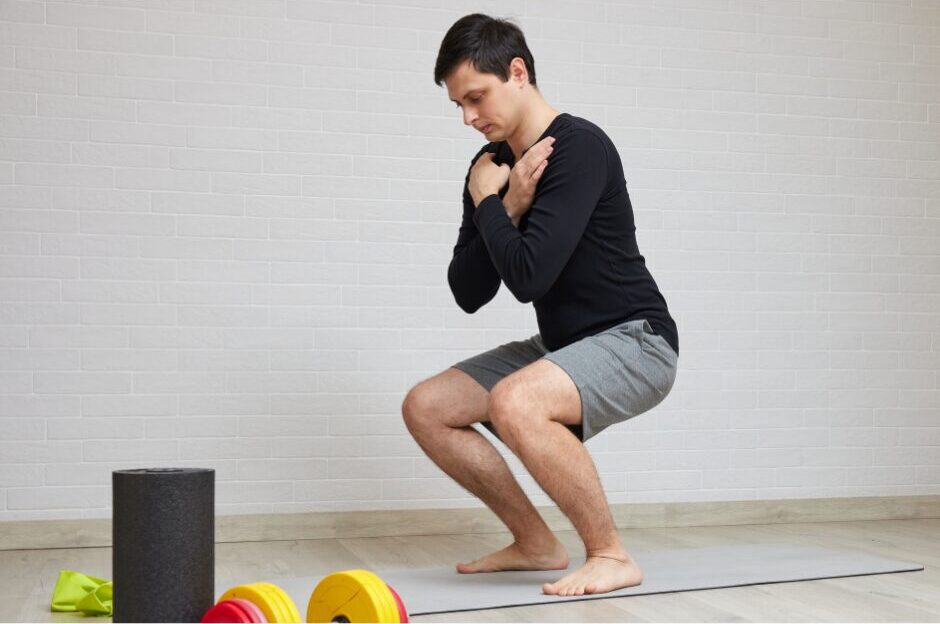
When was the last time you sat on the floor? For many of us, as the years go by, the ground becomes a place we actively avoid because it simply feels too far away. We transition to a life spent entirely at waist-height—moving from beds to car seats, to office chairs, and soft sofas.
At Pure Health Osteopath Clinic in Weston-super-Mare, we look at your relationship with the floor as one of the ultimate indicators of functional longevity.
Following on from our recent focus on future-proofing your movement, today we are breaking down the Ground-to-Stand Game—and why keeping your ability to get down to the rug and back up again is your best insurance policy for lifelong independence.
The Prevention Phase: Why Active Adults Need the Floor
If you are in your 20s, 30s, or 40s and consider yourself active, sitting on the floor might not feel like a priority. Your day might be occupied with demanding work at a workbench, prepping meals at a kitchen unit, or working on a professional clinic plinth.
However, by avoiding the floor, you miss out on the best “opportunistic strengthening” your body can naturally get. When you don’t travel all the way to the ground, the deep muscle groups in your hips, core, and ankles forget how to coordinate under your own body weight.
Prevention here means making the floor a normal part of your day. By choosing to sit on the rug to stretch, play with your children, or watch TV, you force your joints to maintain their full mechanical range. You keep your structural framework adaptable so it never becomes heavy, stiff, and sluggish.
The Restoration Phase: Reclaiming Confidence and Independence
In later life, the floor often transforms from a place of rest into a source of anxiety. The fear of getting stuck down there causes many people to stop trying altogether. When we stop moving through that full, deep range, our leg strength diminishes, and our balance systems begin to degrade.
Restoration isn’t about jumping back up to your feet without using your hands on day one. It is about systematically removing that fear and rebuilding your confidence.
You can safely practice this at home by using a sturdy piece of furniture, like a heavy chair or the side of the sofa, as a helper. Practice lowering yourself down to one knee, transitioning to a seated position, and then using the support to assist you back up. By breaking the movement down into manageable pieces, you send a powerful signal to your nervous system that you still expect your legs to carry you.
How to Play the “Ground-to-Stand Game” This Week
To keep your joints honest, try weaving these micro-habits into your normal routine:
- The “One-Hand” Progression: If you currently need both hands, a knee, and a bit of momentum to get up from the floor, try to use just one hand today. Small, incremental challenges build serious functional strength over time.
- The Sofa Audit: Notice how low and soft your favorite chair is. If your body never has to work to get out of a seat, it will gradually lose the ability to do so. Spend just ten minutes an evening sitting on the floor instead.
- The Symmetry Check: Pay attention to which leg you naturally want to step forward with when you stand up. Try switching to your non-dominant side to help distribute your pelvic and hip strength evenly.
Removing the “Handbrakes” with Osteopathy
If your knees click, your lower back pinches, or your ankles feel completely locked solid when you attempt to get down to the ground, it is a clear sign that your joints have adapted too well to a chair-bound world. When one area lacks the flexibility to bend, your body loses its ability to distribute your weight evenly, making the floor feel like an impossible mountain to climb.
As a local Weston-super-Mare osteopath, my goal is to track down these specific mechanical limitations. By releasing restricted joint capsules in the hips, knees, and ankles, and ensuring your pelvis moves freely, we take the extra strain off your lower back. We clear the structural path so that traveling to the floor feels comfortable, safe, and natural at any age.
Your body is designed to interact with the ground, not just sit above it. Whether you’re looking to maintain your physical resilience for a manual trade or preserve your absolute independence into retirement, let’s make sure you stay friends with the floor.