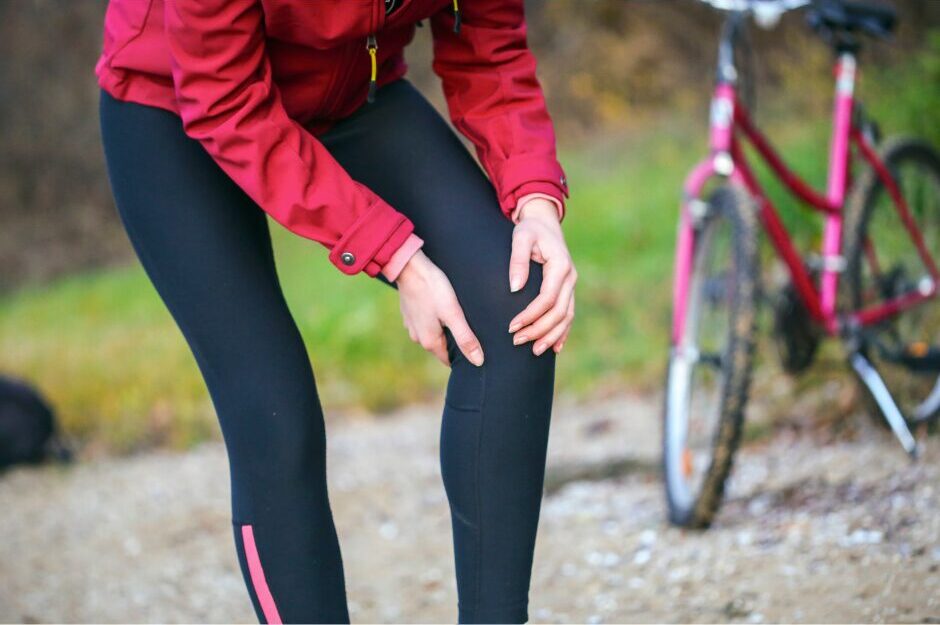
With the long summer days finally arriving across Somerset, many of us are dusting off our bicycles. Whether you are planning a scenic weekend ride out towards Brean Down, navigating the local routes around Weston-super-Mare, or clocking up training miles on a stationary bike at home, cycling is an exceptional way to boost your cardiovascular health and enjoy the fresh air.
However, from an osteopathic perspective, cycling presents a very specific physical challenge. Unlike walking or hiking—where your joints constantly adapt and shift to varying, uneven terrain—cycling forces your body into a highly repetitive, mechanically fixed position.
Following on from our discussion last week about the cumulative strains of summer walking, today we are breaking down why the saddle can sometimes trigger repetitive strain in your knees and neck, and how to condition your framework to handle the miles smoothly.
The Fixed Position: Why Predictability Causes Strain
When you click your feet onto a bicycle, your hips, knees, and ankles are locked into a single, unyielding plane of movement. During an average hour-long ride, your legs might perform over five thousand identical pedalling revolutions.
While this mechanical predictability is highly efficient for generating speed, it means that if your structural framework has any existing limitations, your joints cannot shift to distribute the load. Instead, the exact same tissues take the brunt of the force, thousands of times over.
Two common mechanical bottlenecks tend to appear during summer cycling:
1. The Front-Knee Pinch (Patellofemoral Tracking Issues)
Your kneecap is designed to slide smoothly up and down in a shallow groove at the front of your thigh bone. However, if your hip flexors or outer thigh tissues are already shortened from hours spent sitting at an office desk, working at a manual workbench, or prepping at a kitchen unit, they exert an uneven pull on the kneecap. Over a long ride, this repetitive friction causes a dull, grinding ache right at the front of the joint.
2. The Handlebar Hunch (Neck & Upper Back Stiffness)
To keep your eyes on the road ahead while leaning forward over the handlebars, you have to crane your neck backward. If your upper back (thoracic spine) is already stiff from the daily grind, it cannot assist in creating a smooth, gentle curve. As a result, your upper neck joints have to take the entire weight of your head in a compressed position, often resulting in burning shoulders or a nagging tension headache by the time you cycle home.
Three Mechanical Resets for Your Next Ride
To ensure your body can comfortably meet the physical demands of the saddle, try weaving these simple conditioning habits into your cycling routine:
- The Glute Wake-Up (Before Your Ride): Before you swing your leg over the frame, perform 10 slow, deliberate bodyweight squats. Focus on squeezing your glutes at the top of the movement. This simple step encourages your large hip muscles to do the heavy lifting, taking the excess pressure off your quads and kneecaps.
- The “Float” Check (On the Bike): If you use clip-in cycling shoes, ensure your cleats are adjusted to allow for a few degrees of natural lateral rotation (known as “float”). This small margin of error allows your foot to find its natural alignment, preventing rotational stress from traveling straight up into your knee joint.
- The Chest Opening Counter-Stretch (After Your Ride): When you finish your route, resist the urge to immediately sit down. Stand tall, interlace your fingers behind your back, and gently roll your shoulders backward while lifting your chest. This simple position opens up the front of your hips and reverses the compressed “handlebar hunch” of your spine.
How We Help at Pure Health Osteopath Clinic
If your knees protest every time you tackle a local hill, or your neck feels completely locked up after a morning ride, it is a sign that your body’s mechanical adaptability is hitting a wall. If a hip joint or an ankle is restricted in its movement, your knee is caught directly in the middle—forced to twist slightly out of its optimal alignment just to complete the pedalling circle.
As a local Weston-super-Mare osteopath, my goal is to restore fluid, balanced function to your whole structural system. By improving the mobility of your hips and ankles, we ensure your knees can travel in a clean, straight line without friction. We also work to release the compressed tissues in your upper back and neck, making it significantly easier for you to look down the road comfortably and enjoy the summer scenery pain-free.
Your body shouldn’t have to fight your bicycle. Whether you are a casual weekend cyclist or prepping for a major summer challenge, let’s make sure your joints are moving beautifully before you hit the road.